
“Could you bring home kimbap?” I asked my husband. He came back with sushi. I know he was trying to bring me something I would like, and I know why the mistake happened: in America, a cylinder of rice wrapped in seaweed is so often called “sushi” that a different name can sound like a minor detail. But I had asked for kimbap. I was imagining sesame-scented rice, a bright strip of pickled radish, cooked egg and vegetables, a roll sliced into the kind of portable meal I grew up recognizing. The sushi was lovely. It simply wasn't the food I had been craving.
That small mix-up is funny now, but it also explains why I wanted to write this guide. When a food from one culture is described only through another culture's familiar word, the ingredients become harder to recognize and the person asking for it has to explain herself all over again. I don't want to make a competition out of two delicious traditions. I want to give each its own name. Kimbap is Korean. Sushi and makizushi are Japanese. They can both involve rice, seaweed and a rolled shape, yet the rice seasoning, the way fillings come together and the meal each roll suggests are often very different.
This is a look at the many kinds of Korean kimbap, the varieties drawing attention now, and the practical clues that help an American diner tell a Korean rice roll from a Japanese sushi roll. It is also a little note to my husband: if I say “kimbap,” please take me to the Korean place.
Start with the name, then look inside
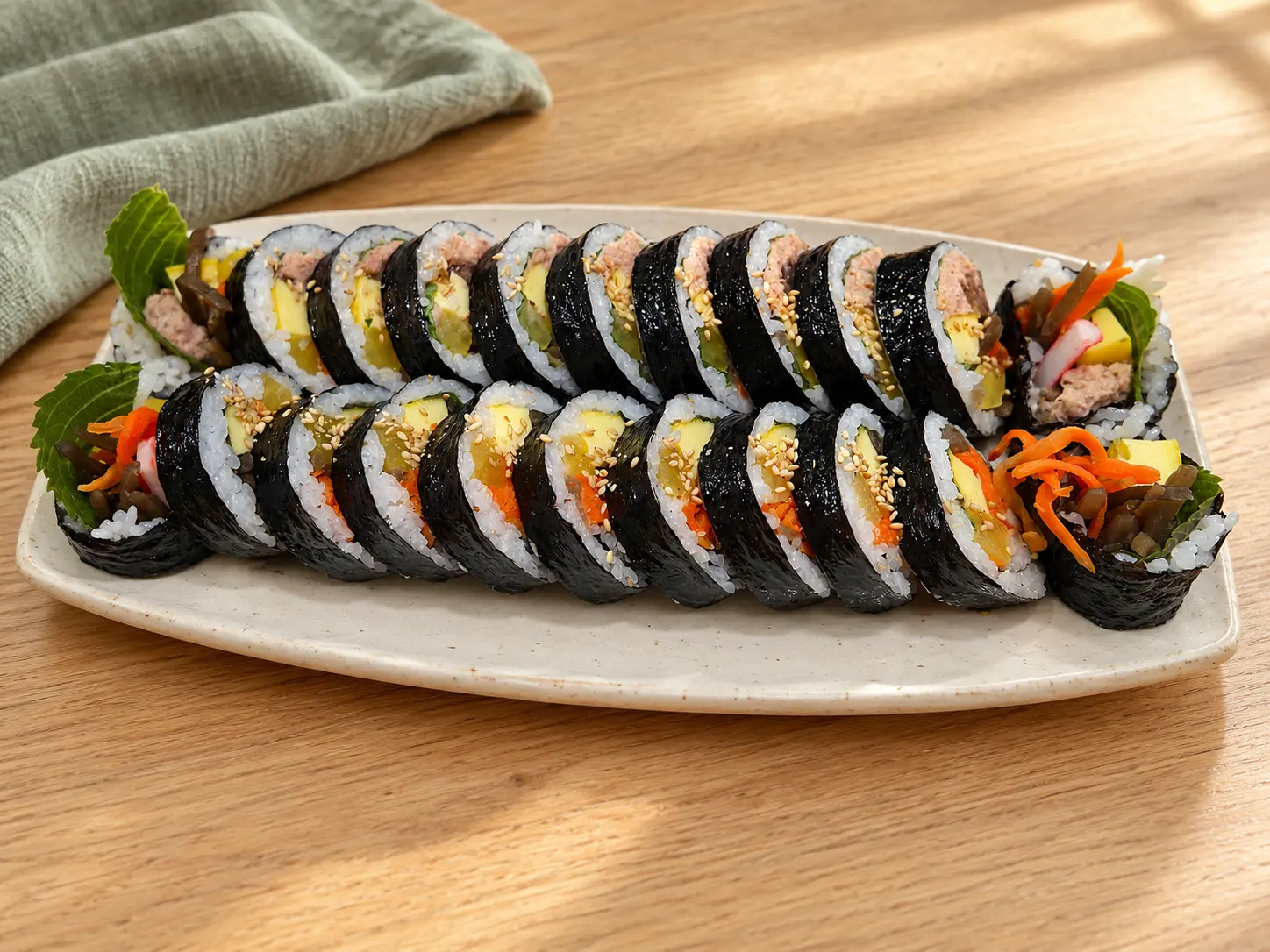
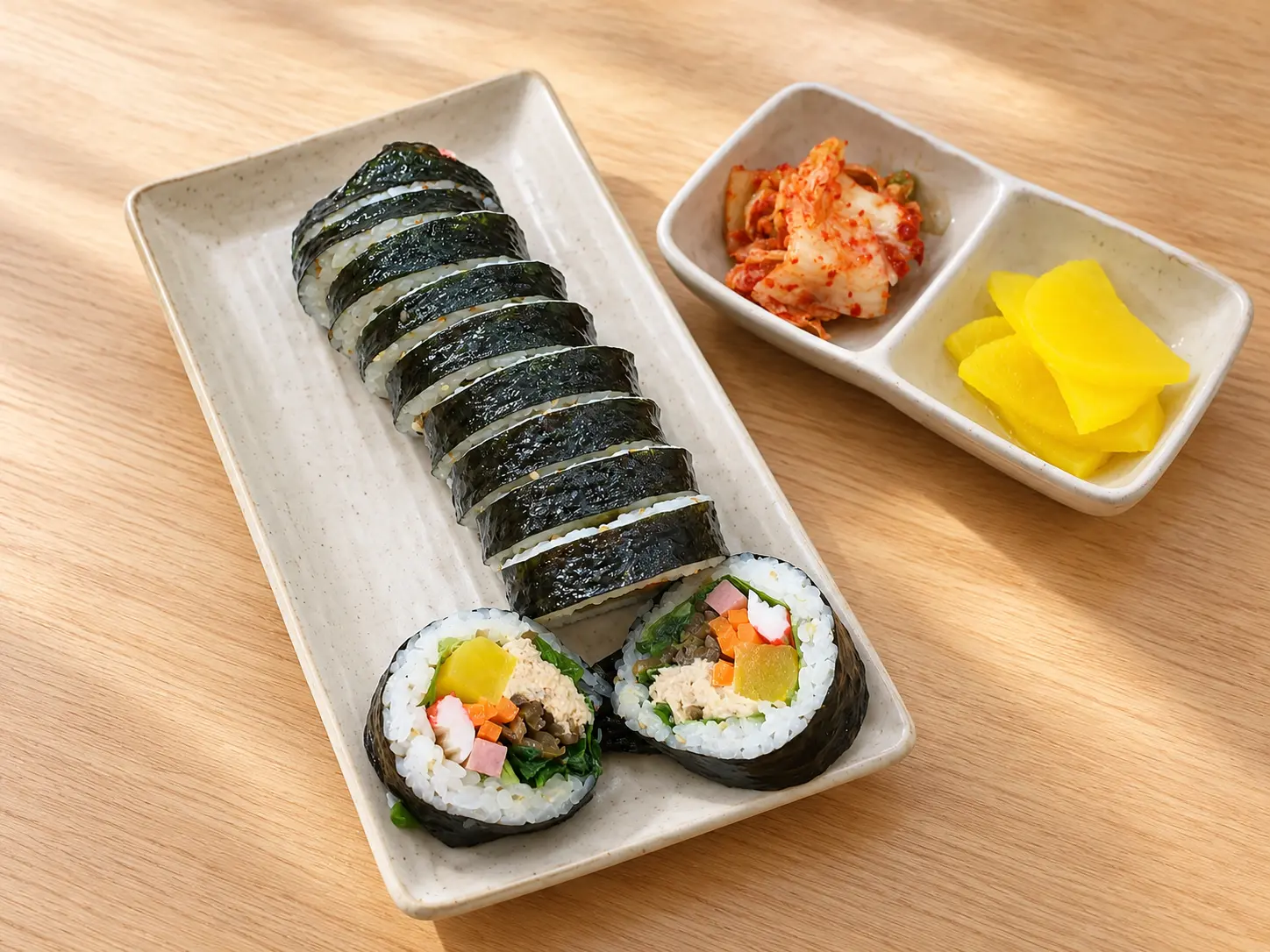
Gim (김) is the dried seaweed sheet and bap (밥) is cooked rice. “Gimbap” is the romanization you will see in many Korean tourism and official sources; “kimbap” is also widely used in English menus. They refer to the same Korean food here. A typical full-size roll layers cooked rice and prepared fillings over gim, rolls them into a log and cuts them into bite-size pieces. You may see yellow danmuji, orange carrot, green spinach, brown burdock, pale egg, beef, tuna, tofu or other ingredients in the cross-section. There is room for a neighborhood shop's signature and a family's own preferences.
Sushi names a Japanese family of dishes built around seasoned, vinegared rice. Makizushi is the rolled member of that family; maki means roll. Nigiri is a shaped mound of sushi rice with a topping, and temaki is a hand-rolled cone. So “sushi roll” is useful English for makizushi, but sushi itself is wider than rolls. A salmon-and-cucumber maki may resemble kimbap from across a room. A slice tasted slowly makes the distinction easier. The sushi rice brings a gentle sweet-tart note from vinegar. In a common kimbap, salt and toasted sesame oil give the rice a savory, nutty aroma. Those are tendencies worth learning, not rigid tests that erase regional or contemporary variations.
| Question | Korean kimbap | Japanese makizushi |
|---|---|---|
| What seasons the rice? | Often salt and toasted sesame oil; sometimes sesame seeds, with variations by cook. | Sushi vinegar, commonly made with vinegar, sugar and salt. |
| What might fill it? | Prepared vegetables, egg, pickles, cooked meat, tuna, cheese and many other combinations. | Raw or cooked seafood, egg, cucumber, seasoned vegetables, tofu or other ingredients. |
| What finishes the outside? | Often a light brush of sesame oil and sesame seeds on gim. | Nori may be outside or inside; the rice and garnish remain the defining sushi elements. |
| How is it often eaten? | A complete portable lunch, picnic food or bunsik snack, sometimes with ramyeon or tteokbokki. | Part of varied Japanese sushi meals, from casual rolls to formal service. |
Notice the word often. Chungmu gimbap has plain rice inside little rolls and is not coated in sesame oil; its spicy companions are served on the side. Some Korean rolls use less rice or even egg in its place. Some Japanese rolls contain only cooked ingredients and vegetables. The comparison helps us order the right lunch, not police someone's kitchen.
Rice is the first clue
If I had to explain the difference to my husband in one breath at the grocery store, I would start with rice. Cooked short-grain rice gives both foods a way to hold their shape, but the seasoning directs the taste. In much everyday kimbap, warm rice is gently seasoned with a little salt and toasted sesame oil. The oil does not need to make the rice greasy. It lifts the aroma as you open the box and gives the other prepared ingredients a savory base. Sesame seeds may be folded in or sprinkled over the finished roll. The rice is a comfortable background for the crunch of danmuji and the softness of egg.
Japanese sushi rice, often called shari, is seasoned with sushi vinegar. A Japanese Ministry of Agriculture example for makizushi mixes vinegar, sugar and salt before folding that mixture into cooked rice. Its slightly sweet acidity is intentional. It can balance a rich fish, a simmered mushroom or a thin omelet. That flavor is not a flaw in sushi; it is part of what makes the food itself. I like sushi when I ask for sushi. The problem arrives when a familiar-looking roll is assumed to have the flavor of another country's dish.
Can kimbap ever contain vinegar? Yes; there are Korean variations and home cooks do not sign a single rulebook. A Korea Tourism Organization description allows for plain or seasoned rice, including some vinegared preparations. Can a sushi chef make rolls without raw fish? Absolutely. Rice seasoning is a useful starting point, supported by official descriptions of both foods, but the name, recipe and dining tradition give the complete answer. If you cannot taste before ordering, ask the shop how its rice is seasoned and what it calls the roll.
Gim, nori, and the finish on the outside
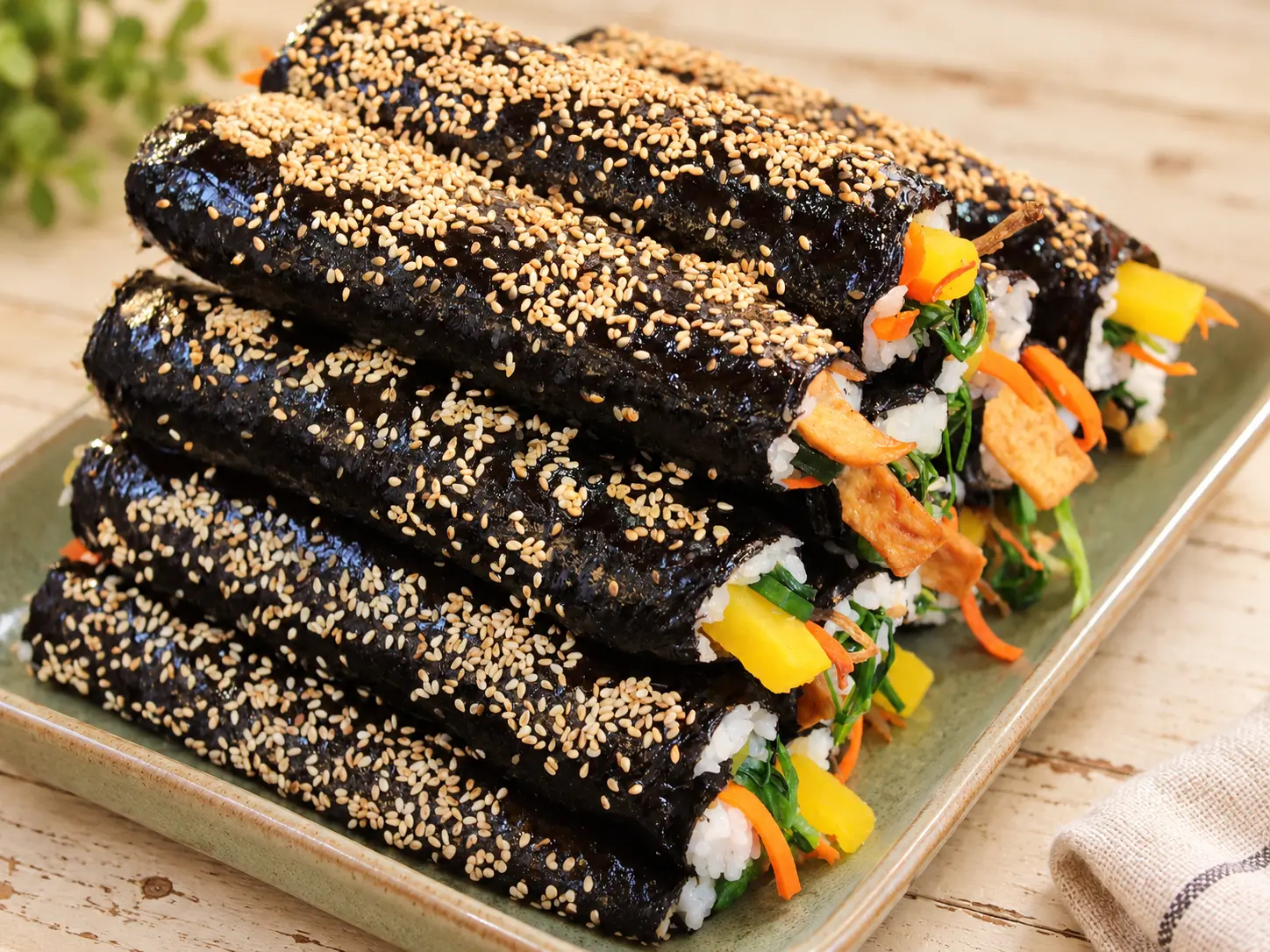
Both foods can use a dried seaweed sheet, and that shared material is one reason an American shopper reaches for the word “sushi.” In Korean, the sheet is gim; in Japanese, it is nori. Those names are not labels pasted onto identical finished meals. They tell you which kitchen and which set of decisions you are entering. In a familiar kimbap, the cook spreads the seasoned rice thinly over gim, lines up already prepared fillings and rolls firmly. The outside may receive a light brush of sesame oil and a scattering of sesame seeds before slicing. That last touch makes the roll shine and perfumes a lunchbox as soon as the lid opens.
A makizushi cook can also roll rice and filling in nori with a bamboo mat. Some Japanese rolls place rice on the outside and nori inside, a style called uramaki. American sushi menus may build on that form with avocado, cooked crab or sauces. A roll's exterior alone therefore cannot certify its identity. Nor does the presence of sesame automatically make something Korean. If an American restaurant borrows from both cuisines, its menu may describe a fusion roll. That can be enjoyable when it is named honestly. The useful question is what dish the kitchen intended to make and how it seasoned and combined the ingredients.
When I make or pack a Korean roll, I care about the slice holding together. The gim should meet rice that is spread evenly rather than piled high; the fillings should be long enough to run from end to end; the seam should rest before the knife goes through. A torn edge or an untidy end piece is ordinary home cooking, not proof that the roll has failed. The way the finished pieces sit together on a plate is part of why kimbap feels generous: each slice offers the whole arrangement again.
The meaning of a meal you can carry
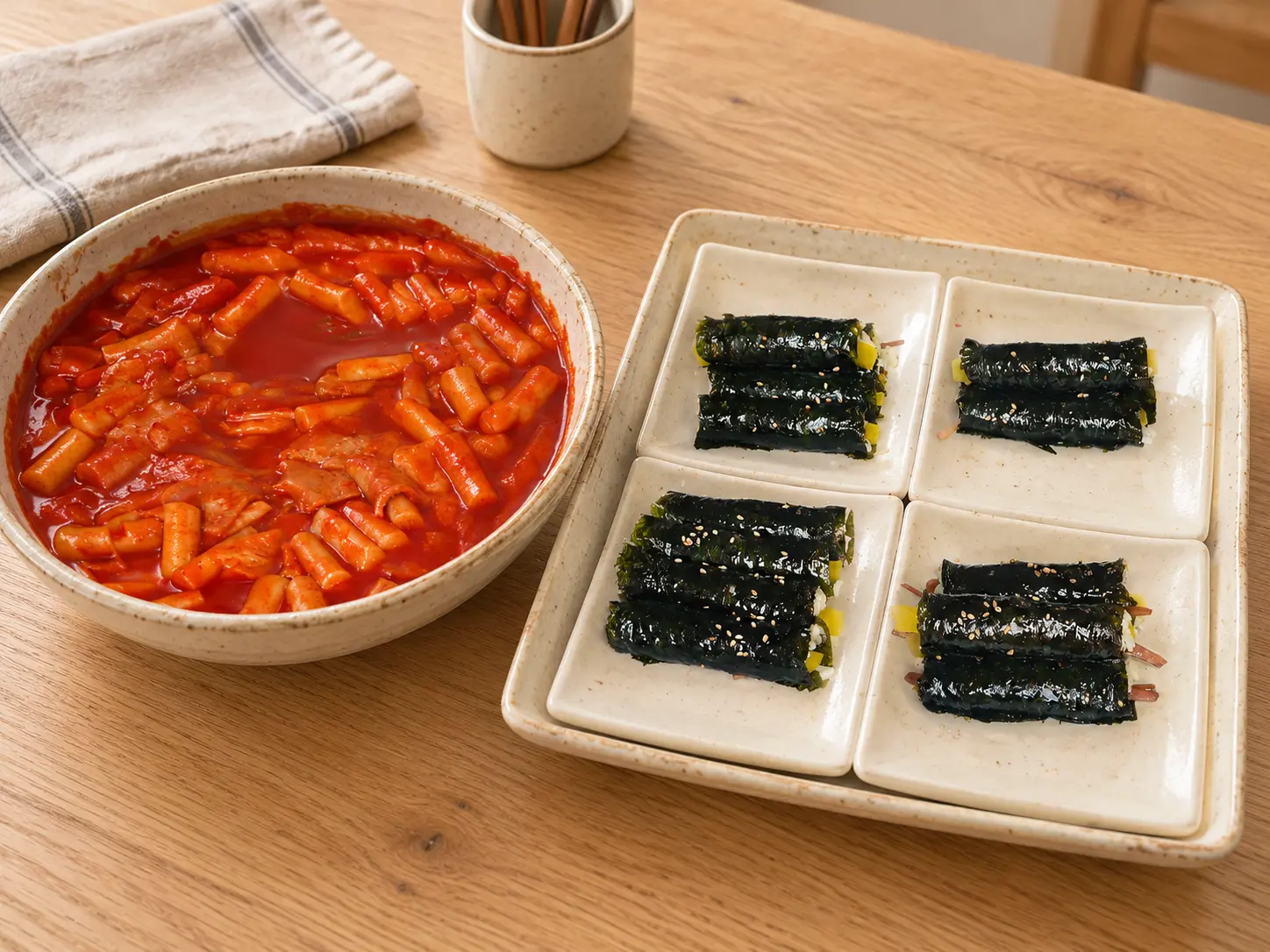
Kimbap is wonderfully portable. A roll can be sliced for a picnic, carried home from a neighborhood bunsik shop or packed into a dosirak. It can be a whole lunch rather than an opening course. In Korea, a plate of kimbap often makes sense beside ramyeon, udon broth or tteokbokki. The rice soaks up a little spicy sauce; the pickle inside gives the next bite a crisp reset. None of these pairings is mandatory. They are the small social settings that make the dish recognizable beyond its photograph.
I think about lunchboxes when I explain this to my family in America. A rolled lunch is easy to portion, easy to see at a glance and easy for a child to pick up. I began packing school lunches after my daughter told me she could not eat the school food, while my son came home so hungry that I understood his own lunch was not working for him. I wanted the food they trusted at home to travel with them. Kimbap fits that thought: rice, vegetables and a filling can be arranged into a compact meal. That is my family experience, not a rule for every Korean household or a judgment about every American cafeteria.
Japanese sushi has its own many settings, from supermarket lunches to a carefully paced restaurant meal. It would be inaccurate to say sushi is always fancy or kimbap is always humble. I have bought a quick sushi roll and admired an elaborate Korean roll. What differs is not a social rank. It is the set of flavors and food memories that comes with the name. When I asked for kimbap and received sushi, I missed the sesame aroma, cooked fillings and familiar lunchbox feeling, even though the sushi was perfectly good.
What a Japanese sushi roll actually is
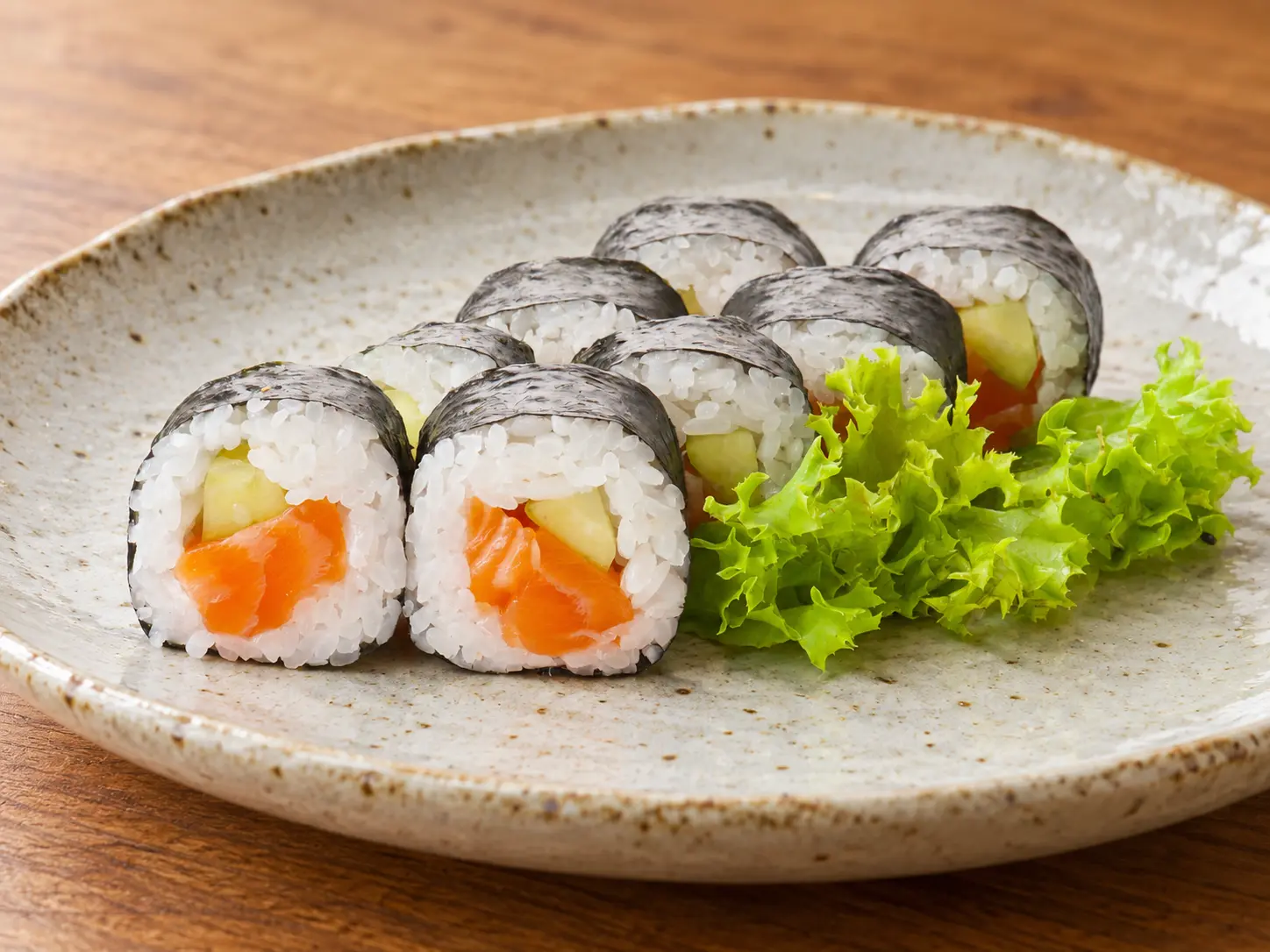
Let's give the Japanese roll the same care we give the Korean one. Makizushi places sushi rice and one or more fillings on a nori sheet, then rolls and cuts it. The Japanese Ministry of Agriculture's ehomaki example includes vinegared rice with seasoned shiitake, dried gourd, tofu, egg and cucumber. That is a cooked-and-vegetable roll. Raw fish is not required for a dish to be sushi. Japan's national tourism guide also describes egg and vegetables as possible sushi partners and lists makizushi alongside nigiri, temaki, chirashi and other forms.
That matters because an easy explanation can become another misconception: “Kimbap has cooked fillings; sushi has raw fish.” One real makizushi might be cucumber and egg, while a Korean roll could contain tuna or a creative seafood filling. If we teach only a raw-versus-cooked divide, we will confuse the next person who orders a cucumber maki. The more durable distinction is culinary identity: Japanese vinegared sushi rice is central to sushi; a Korean kimbap roll usually follows a different rice-seasoning and filling tradition. The two are close enough visually to invite questions and different enough that their names should be respected.
Nor is sashimi a synonym for sushi. Sashimi is sliced fish without sushi rice; Japan's tourism guide makes that point explicitly. A California roll belongs to the world of sushi rolls, though the rice-outside style has a strong life abroad. “Sushi” is not one shape, one fish or one price. When I correct someone who calls my kimbap sushi, I am not saying Japanese food is simple. I am asking that Korean food receive the same precision that Japanese food deserves.
The everyday roll many people meet first
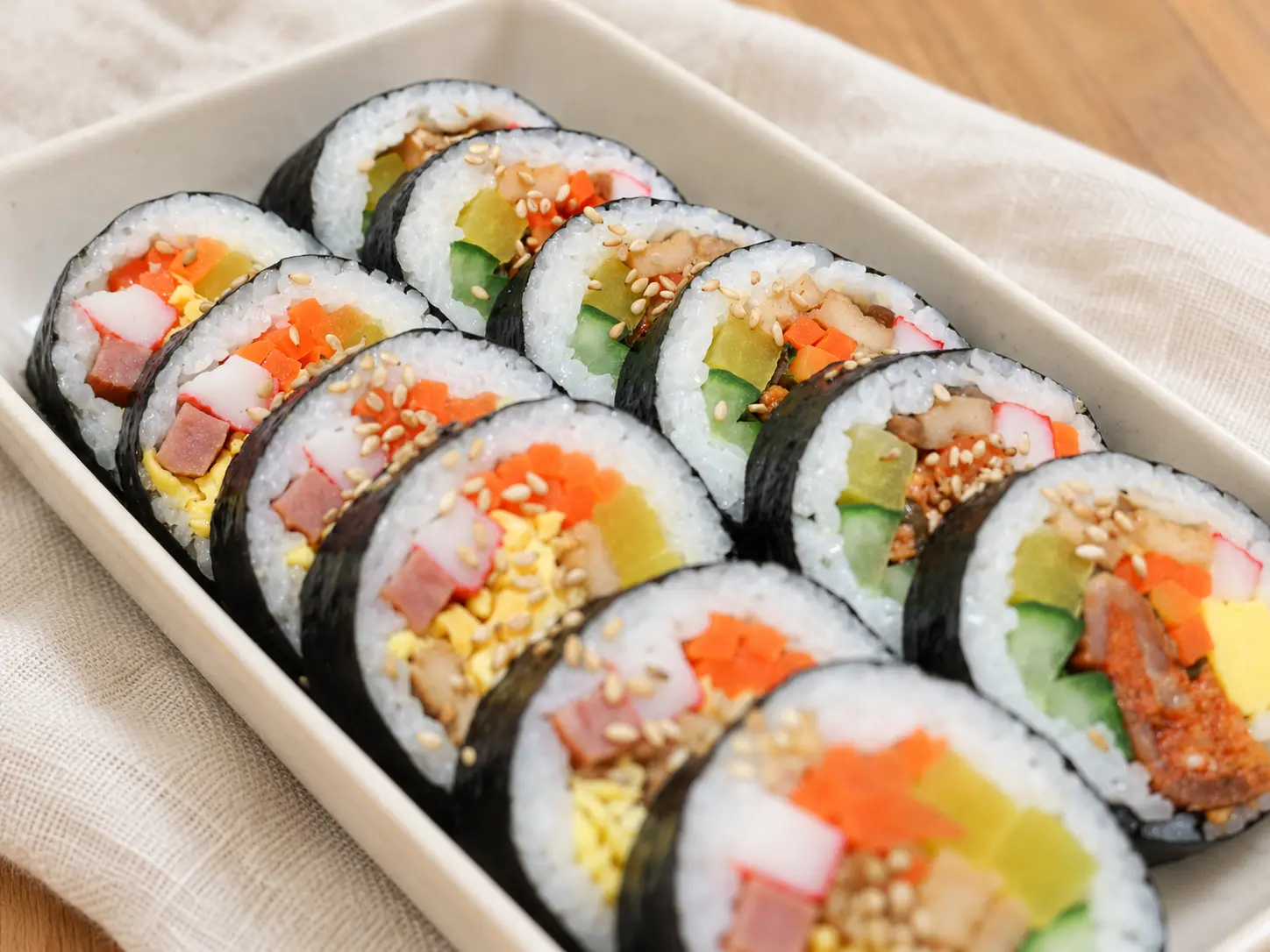
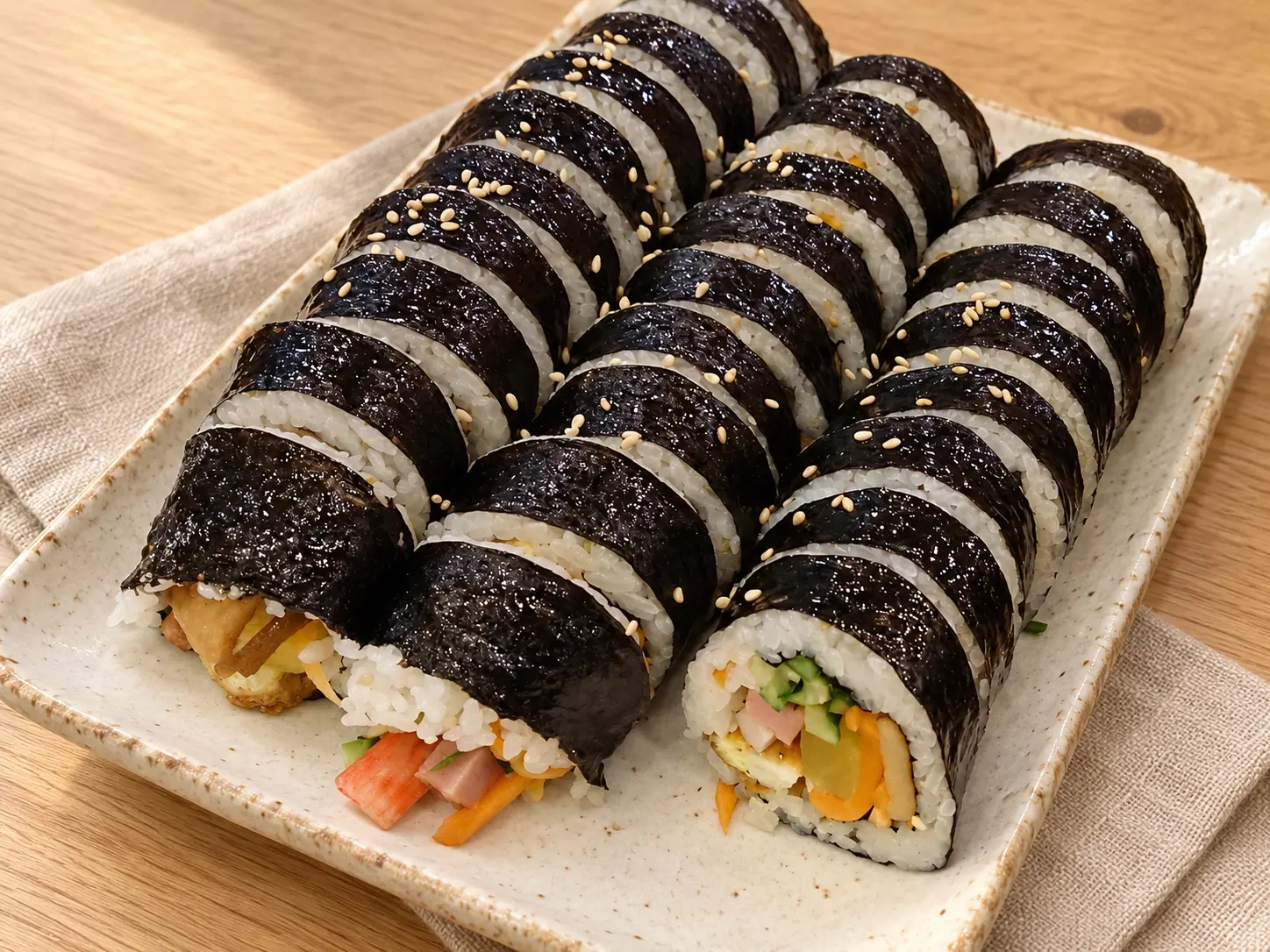
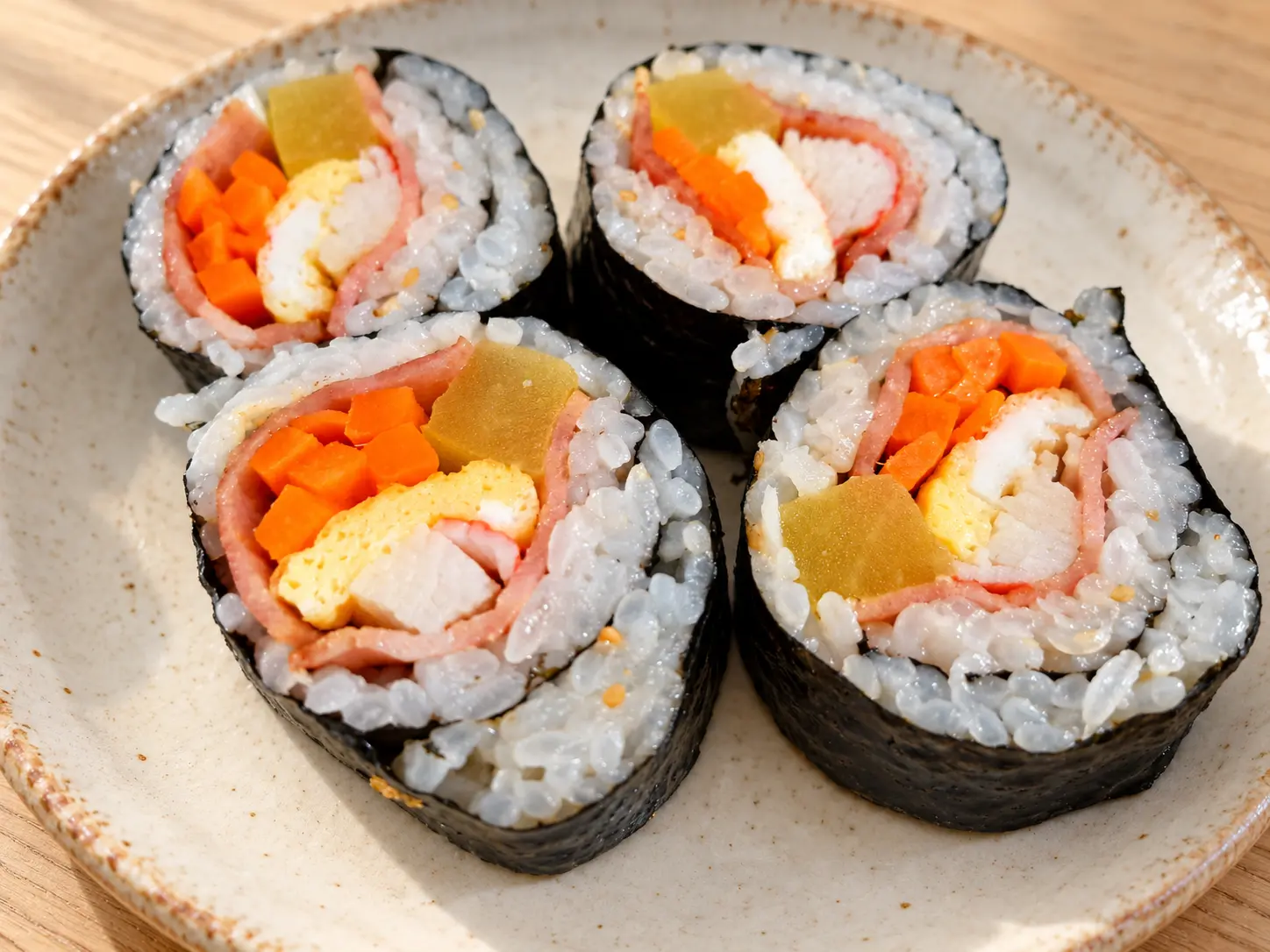
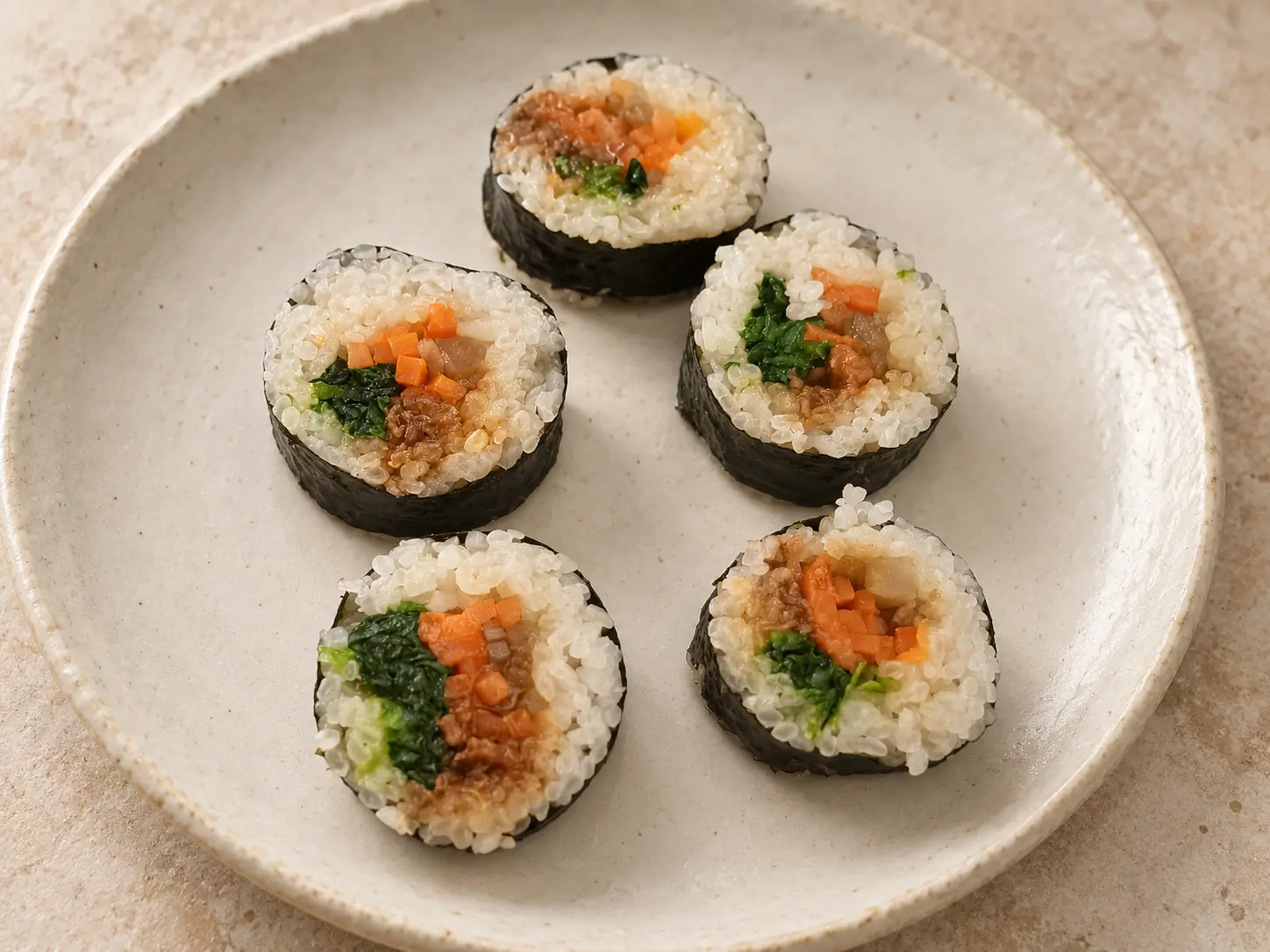
A familiar vegetable-and-egg kimbap shows why one slice can feel like a small complete plate. Carrots bring sweetness and color. Spinach or another green brings a softer, savory note. Yellow pickled radish, danmuji, adds sweet-sour crunch. Burdock root may be simmered until pleasantly chewy. Strips of egg soften the center. Some shops add ham or imitation crab; others leave meat out. The order matters in the hand more than on paper: a little of several things should reach you in one bite without a single filling overpowering every neighbor.
If you are new to kimbap, try this sort of classic roll before assuming every menu version should be spicy. The exterior can be dark and shiny, while the center is a bright set of familiar cooked and pickled ingredients. It is often a friendly place for a child or a cautious eater to begin. In a vegetarian order, however, do not rely only on the word “vegetable.” Ask whether the roll includes ham, imitation crab, fish-based ingredients or egg. A meat-free roll may still contain egg, and a vegan roll requires checking every prepared component and seasoning.
Good kimbap is about proportion. Too much rice can hide the filling and make each bite heavy. Too much wet filling can split the seam. A thin layer of rice and dry, prepared components let the cook roll tightly without squeezing out the vegetables. When a shop slices the log, you should be able to identify a number of colors, not a blurred paste. This is the version I would show someone who asks, “What makes that different from a sushi roll?” I would offer a piece, then ask them to notice the danmuji and sesame before reaching for a comparison.
Egg kimbap: a generous yellow center
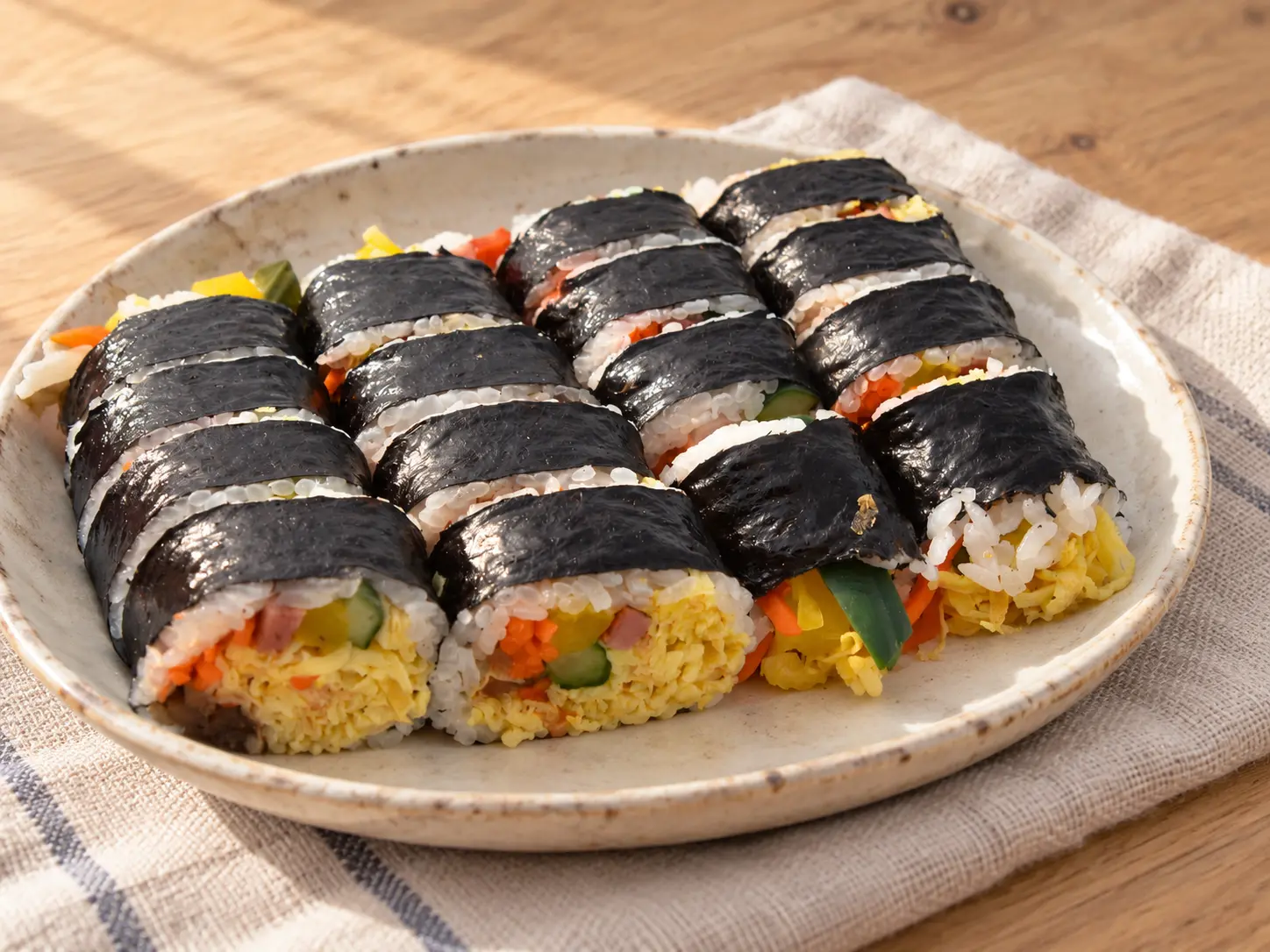
Egg kimbap, or gyeran kimbap (계란김밥), puts egg in the spotlight. One version wraps a thick cooked egg layer around smaller bits of vegetable. Another uses many thin strips of egg. Some lower-rice versions replace much of the rice with egg; others keep a modest rice layer. The name therefore tells you the leading ingredient without promising an identical construction in every shop. In a cut slice, the yellow center can almost look like a sunny circle inside the dark gim.
My egg kimbap lunchbox is built around fully cooked egg, a little rice, carrot and scallion. I like the way a child can see what is inside. The practical work happens before the final roll: the egg should be set enough to travel, the carrot should not bring too much moisture and the rice should be cool enough for safe packing. If an egg log tears while being folded, the slice can still be delicious. Kimbap for a school morning is allowed to be a real family's lunch, with a crooked end piece and all.
Sometimes English menus label egg-forward rolls “keto kimbap.” That can describe a version that uses little or no rice, but it is not a guarantee about a particular nutritional profile. Ingredients and amounts differ. I would rather tell a reader what is in the box than make a sweeping health promise. If the person eating it needs a particular diet, inspect the menu and the actual filling. The joy of the egg version is its texture and color, not a marketing label.
Tuna, perilla, and the comfort of a familiar shop order
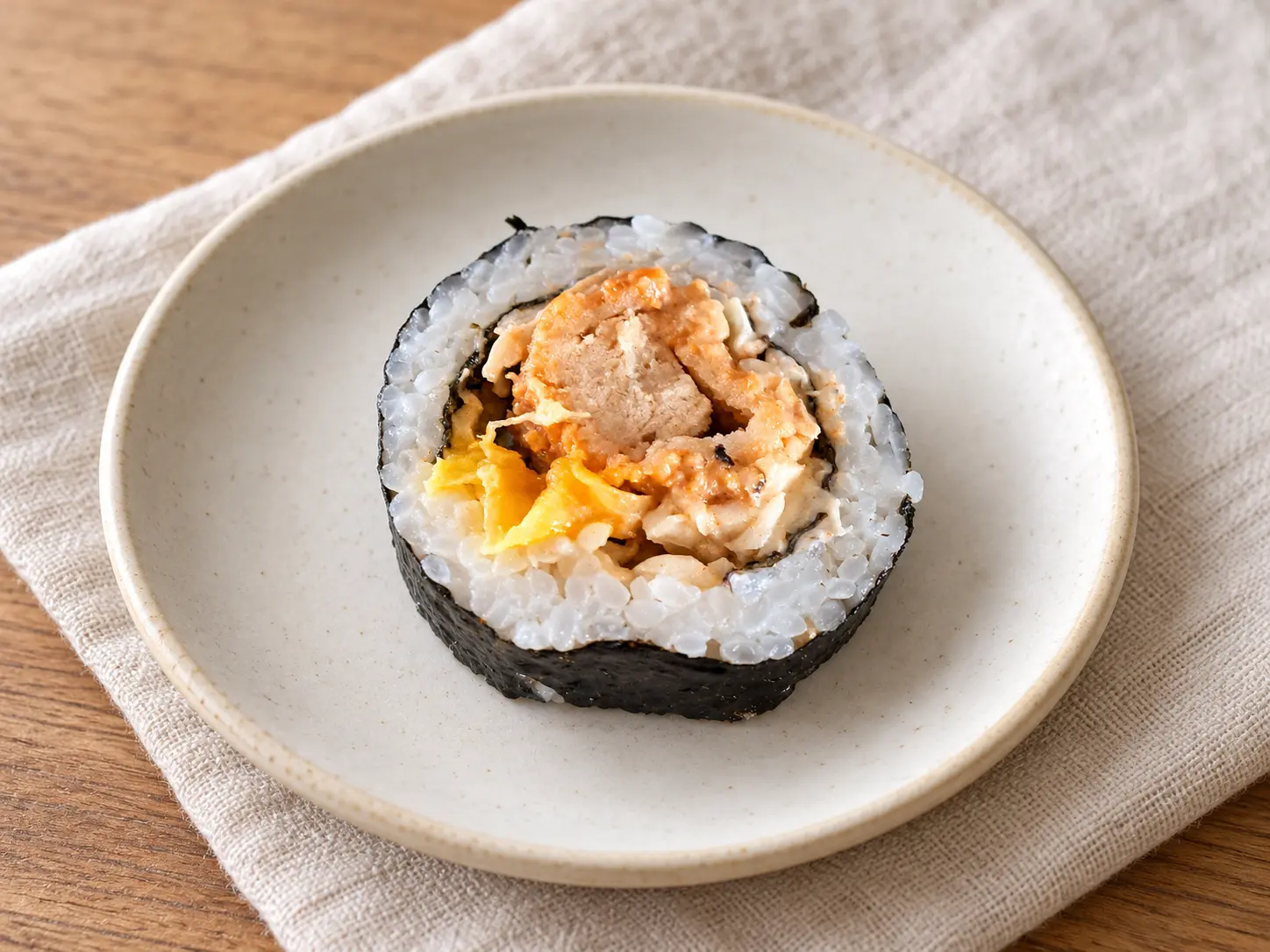
Tuna kimbap is one of the easy orders to recognize in Korea. Canned tuna is often mixed with mayonnaise and tucked beside vegetables and egg. A perilla leaf, kkaennip (깻잎), can form a fragrant layer between the tuna and rice. It brings a green, slightly herbal note that changes the experience more than its thinness suggests. Korea Tourism Organization describes the tuna-and-perilla pairing as a steady seller. I like that it is both familiar and unmistakably itself: creamy tuna, crisp vegetables, sesame-scented rice, and a leaf that says this is not merely a generic seafood roll.
If you are ordering for someone who says they dislike fish, ask whether they mean raw fish, canned tuna or all seafood. A tuna kimbap and a raw tuna maki are not interchangeable just because English uses the word “tuna” for both. Their rice, temperature, texture and seasonings differ. The one in a Korean snack shop may feel closer to a packed tuna lunch with vegetables and rice; the one in a Japanese sushi shop is made within the sushi tradition. Each deserves to be ordered on its own terms.
A practical home note: drain canned tuna well and avoid letting a heavy mayonnaise mixture wet the rice or gim. Keep perishable fillings chilled and follow safe packing practices if the roll will wait for lunch. The goal is a slice that holds its shape and still tastes like the separate ingredients. A roll packed carelessly in the morning should not become a soggy surprise at noon. A little planning is more useful than making the filling extravagant.
Bulgogi, vegetable, and the roll that follows your table
Bulgogi kimbap brings seasoned cooked beef to the center. One Korea Tourism Organization recipe pairs cooked bulgogi with egg, perilla leaf, carrot, cucumber and danmuji, while the rice is seasoned with salt and sesame oil. It is an example of how kimbap can borrow from a familiar Korean meal without becoming a loose bowl of leftovers. The beef needs to be cooked and drained so its sauce does not dissolve the structure. The vegetables still matter; their crunch gives the rich filling room to breathe.
Vegetable kimbap can be just as thoughtful. Start with carrot, cucumber, spinach, burdock, pickled radish or another ingredient that can be prepared in neat strips. Each brings a different texture. A cook can increase the vegetables and reduce the rice, or use tofu or mushrooms for a satisfying meat-free center. I would avoid calling every such roll “vegan” without checking how the vegetables were seasoned and whether egg or fish products appear. The word is a useful request, not an ingredient list.
In America, I also see why a cook may use what is accessible: cucumber from a neighborhood market, local greens, a cheese a child already likes, or a fully cooked protein left from dinner. The honest name can say what was changed. “Bulgogi kimbap” tells the reader where the savory center comes from. “Vegetable kimbap” invites a look at the colors. “My family lunchbox kimbap” can be a home version. The tradition is alive because people keep rolling food they want to eat, not because every roll is frozen in one historical photograph.
Chungmu gimbap and little rolls: why the exceptions matter
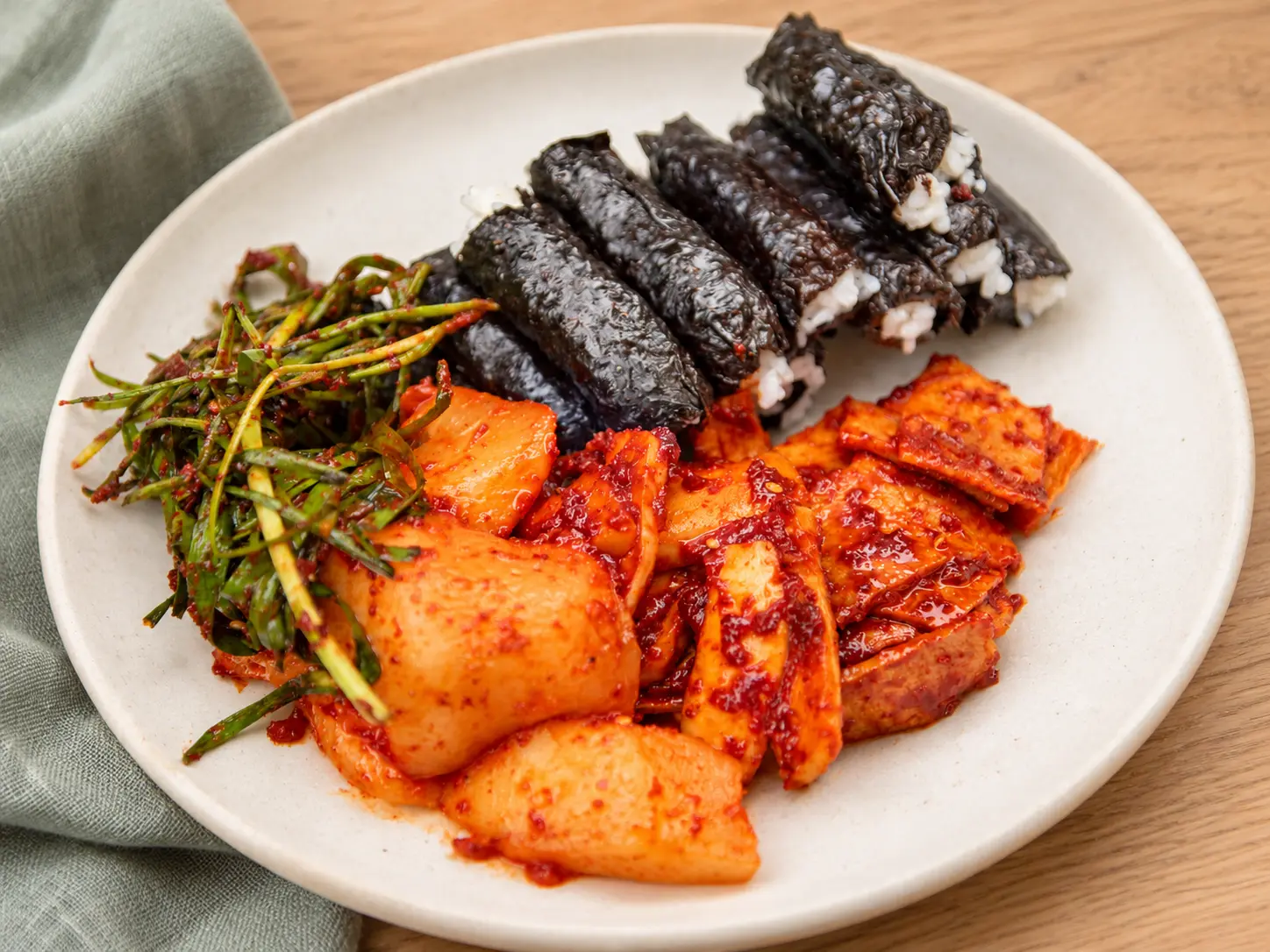
Chungmu gimbap (충무김밥) is the answer I give when a comparison chart starts to sound too certain. These are small rolls of rice wrapped in gim, traditionally served with spicy squid and radish kimchi on the side. The Korea Tourism Organization notes that the rolls themselves have no stuffing beyond plain rice and are not coated with sesame oil. If I had written “every kimbap has vegetables inside and sesame oil outside,” this delicious regional dish would prove me wrong immediately.
The plate is assembled as a conversation. A small, fairly plain roll gives you rice and seaweed; the spicy side dishes bring the strong flavors. You can alternate bites and choose the balance yourself. It feels different from a thick roll where every ingredient is enclosed in each slice. It also reveals something about how Korean food is eaten: a central starch and accompanying dishes can make a complete experience together, even when they are not trapped in the same cylinder.
Small, filled rolls have other lives. You may see mini kimbap called kkoma gimbap or little snack rolls served near tteokbokki. Some are deliberately simple and excellent dipped in the sauce. I do not need to pretend that every small roll is Chungmu style. The plate, filling and accompaniment tell you more than the diameter. If a shop serves a handful of skinny rolls, ask what is inside and what belongs beside them. That conversation is more useful than asking, “Is this tiny sushi?”
Kimchi, cheese, and other bold centers
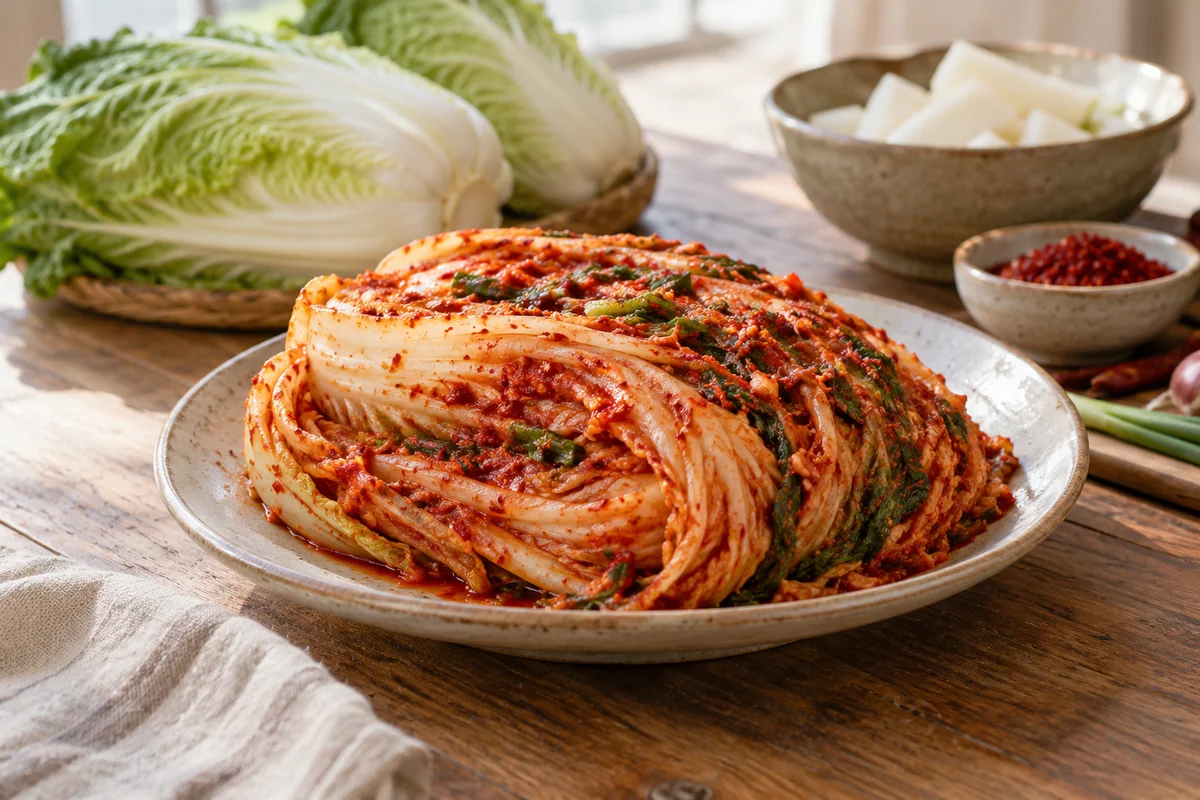
Kimchi kimbap can bring a tangy edge to rice and gim. An aged kimchi filling may be squeezed and combined with tuna, pork or other prepared ingredients so the roll stays tidy. A Korea Tourism Organization guide highlights aged-kimchi-and-tuna and aged-kimchi-and-pork combinations. The idea makes sense to anyone who has learned that ripe kimchi can bring energy to a quiet bowl of rice. But the cook still has to respect moisture: too much liquid seeps into the seaweed and makes the slice collapse.
Cheese kimbap is another approachable variation. A slice of cheddar, a creamy cheese or a warm melted center changes the texture and gives the rest of the vegetables a soft counterpoint. I wouldn't describe cheese as the original heart of every Korean roll, and I wouldn't dismiss it as somehow less real to the person whose favorite neighborhood shop makes it. Korean food has room for contemporary menus and family choices. The honest description is enough: this is kimbap with cheese, and you can decide whether that is the bite you want.
There are also pork cutlet, spicy pork, chicken and seafood versions. The center may be crunchy or richly seasoned, but the same structural questions remain: how much rice, how dry the filling, whether the gim can close and whether each slice delivers the intended contrast. A photo of plain vegetable kimbap should not be passed off as a photograph of a spicy chicken version. In this page, the images show real photographed rolls and their actual visible ingredients; when I discuss another variation, I describe it in words unless the picture truly depicts it.
What feels current in 2026?
“Trendy” needs a date. A flavor described as new in an article from two years ago may already be a familiar neighborhood order today. Korea Tourism Organization's earlier trend feature discussed pollack roe, aged kimchi and customization. Its 2026 Gimcheon Gimbap Festival listing gives a more current, concrete snapshot: taco gimbap, buckwheat-and-egg gimbap, pork-cutlet gimbap, pollack-roe-and-cucumber gimbap, spicy chicken gimbap and locally identified beef or pork fillings appeared on the listed festival menu. The event ran October 23–25, 2026. A festival menu shows creative offerings at one event; it does not prove every Korean household now cooks these at home.
One direction is ingredient-led gimbap. A roll announces its defining center: pollack roe for a savory sea note, a cutlet for crunch, egg for a soft golden interior, or a deeply seasoned meat. Another direction is place-led gimbap, naming local produce or a regional specialty. A third is format-led convenience: a single meal packed, frozen or sold in a form an American shopper can heat and eat. These are my editorial groupings of the reported offerings, not official industry categories. They help me make sense of what I see without calling a single creative roll “the” future of Korean food.
I am especially interested in how a roll adapts without losing clarity. A taco-inspired filling can be playful, but a name should tell me what I am getting. A pollack-roe roll can be deliciously Korean and still be a modern shop invention. A buckwheat-and-egg version might appeal to someone who wants a different balance of grain and protein. I would rather invite readers to taste and ask questions than flatten every new filling into a viral list. Trend watching is useful when it sends us back to the plate with more curiosity.
Frozen kimbap and the American grocery aisle
Frozen Korean kimbap brought the name to shoppers who may never have ordered it from a Korean snack shop. Korea Tourism Organization reported the excitement around frozen imports in the United States in its trend coverage. A 2026 CJ Foods company statement says its frozen line includes bulgogi, spicy pork, vegetable, bibimbap, kimchi cheese and tuna mayo varieties in international markets. That is a brand's account of its own lineup and distribution, not evidence that all frozen kimbap tastes the same or that one company represents every maker.
There is a real opportunity in that freezer door. Someone can read the word gimbap, take a box home and learn that it is not a mislabeled sushi roll. A frozen product also has its own practical realities: follow the specific package directions for heating, cooling and storage. The texture after reheating will not necessarily be the texture of a freshly rolled lunch from a neighborhood shop. Both can be worthwhile, but they are different experiences. If the first frozen roll you try has one filling you dislike, don't decide the whole dish has spoken.
For me the grocery aisle is a useful place to practice naming. The package can say “Korean gimbap,” and the person eating it can say the same. That tiny act leaves room for a more interesting next question: Which kind? What is in the center? Is the rice sesame-scented? Do I want a vegetable one for lunch and a spicy one another day? Recognition begins with a label and grows into taste.
How I would help my husband bring home the right roll
Here is the practical version of my story. I would say: “Please get kimbap from the Korean restaurant. I mean the Korean rice roll with sesame-scented rice, cooked egg, vegetables and pickled radish. A vegetable or tuna kimbap is fine. If the menu only says salmon maki or California roll, that is sushi, so call me first.” It is a little more explanation than a one-word text, but it gives the shopper a destination, a dish name and two familiar choices. That is kinder than expecting him to infer the right meal from a silhouette.
At a store, I would look for gimbap or kimbap on the sign, then read the filling. At a sushi counter, I would look for makizushi if sushi is what I want. If a hybrid menu uses “Korean sushi,” I would ask what the rice seasoning is and whether it is made as kimbap. Some owners may use that English shorthand because it helps new customers find the food; I understand the business reason. As a customer and a Korean cook, I still appreciate seeing the proper name beside a short explanation.
What if the roll looks identical through a clear lid? The label and ingredient list are stronger evidence than appearance. Vinegared rice with a Japanese sushi menu points one way. Sesame-seasoned rice with danmuji, egg and cooked vegetables on a Korean menu points another. Neither a dark wrapper nor a round slice proves anything alone. If the answer remains unclear, ask. Food questions are allowed to be ordinary and friendly.
Making, packing, and keeping a roll pleasant to eat
For a home kimbap, I plan the fillings before I spread the rice. Cook egg and meat fully according to the recipe; prepare vegetables so they are crisp or tender as intended; cool cooked components promptly. Damp ingredients need draining. Place the gim with the correct side against the mat, spread a thin, even layer of seasoned rice and leave a clear strip to seal. Line up the fillings across the sheet, roll with steady pressure and rest the seam underneath. A lightly oiled knife can make neater slices. These are practical general steps, not a substitute for the quantities and safe timing in a complete recipe.
For a school or work lunch, rice, egg, meat, fish and many vegetables are perishable. I pack the finished roll cold in an insulated bag with cold sources, or keep it refrigerated until it is eaten. I do not assume that a childhood picnic memory makes a modern lunchbox safe on a warm day. A frozen product follows its manufacturer's directions. A freshly made roll has the nicest texture soon after preparation, but food safety still comes first. If you want a detailed example, my egg kimbap recipe explains its own cooked-egg and school-packing method.
There is also a sensory reason to plan. Rice that is crushed into a paste loses the grain texture I want to see. A very thick rice layer makes the filling disappear. Wet vegetables make the seaweed soft before lunch. A small amount of sesame oil should perfume, not saturate, the roll. These little decisions add up to a slice that tastes like several prepared components together. They are the reason I prefer to describe kimbap as a composed meal rather than “Korean sushi.” The shorthand never tells you how carefully the parts were made.
Questions I hear at the table
Is kimbap just Korean sushi? No. The shared rolled shape is real, but kimbap is a Korean dish with its own rice seasoning, prepared fillings, names and eating contexts. Sushi is a Japanese family of dishes defined around sushi rice; makizushi is its rolled form. A comparison can help someone begin, but the proper name should be the destination.
Does sushi always contain raw fish? No. Japan's official food and tourism sources describe vegetable, egg, tofu and other cooked makizushi. Sushi rice remains the key clue. Likewise, a Korean roll can include seafood. Raw versus cooked is too blunt a rule for either tradition.
Is kimbap always made with sesame oil? No. It is common in many familiar versions, but Chungmu gimbap is a documented example without an oil coating, and home recipes vary. If sesame is an allergy concern, check the specific product or restaurant rather than relying on a general description.
Is every vegetable kimbap vegan? No. Egg, imitation crab, fish-based seasonings or other animal products may appear in a roll or its prepared components. Ask for the ingredient list. Egg-forward “keto” versions are not vegan, and the word “vegetable” describes a focus, not necessarily every ingredient.
Does a California roll count as kimbap because it has rice and seaweed? No. It belongs to sushi-roll traditions. Rice outside the seaweed, avocado and cooked crab are clues in many American examples, but the menu's identity and the rice preparation matter more than any one ingredient.
Why does my Korean roll have no vegetables inside? You may be looking at Chungmu style, whose small plain rice rolls are served with spicy side dishes. Or you may have a different local variation. Ask what is served with it before concluding that it is incomplete.
A name is an invitation to taste more carefully
The next time my husband and I talk about dinner, I will still happily say yes to sushi when sushi sounds good. I will also say kimbap when I want kimbap. That small precision gives us more choices, not fewer. He can learn that I may be craving the soft egg, crisp danmuji and sesame aroma of a Korean roll; another evening I might want the bright vinegared rice and a salmon maki. We can enjoy both foods without asking either to stand in for the other.
What I hope an American reader carries away is simple: ask the name, notice the rice, look at the filling and respect the kitchen that made it. Try classic vegetable kimbap, then tuna with perilla or an egg-centered lunchbox roll. Seek out Chungmu gimbap if you want to see how the small plain rolls and spicy sides work together. Be curious about a creative festival filling without assuming every novelty is tradition. When a Japanese makizushi sounds good, order it by name and appreciate its own craft. There is plenty of room at the table for both.
And if someone you love asks you to bring home kimbap, you now know why a sushi tray, however thoughtful, might make them laugh and sigh at the same time. The word carries a flavor, a meal and a memory. Bring home the right roll, and perhaps bring enough to share.